
Planning a Sabarimala pilgrimage in 2026-27 starts with two essential checks: whether the temple is open on your travel date and whether you have a valid Virtual Queue slot.
Unlike temples that remain open throughout the year, Sabarimala Temple follows specific pilgrimage seasons, monthly pooja openings, and festival schedules. The main Mandala–Makaravilakku season usually runs from around mid-November into January, while shorter opening periods take place during selected Malayalam-month poojas and important festival days.
For most pilgrims, Sabarimala Virtual Queue booking is the main system used to manage darshan access on temple-opening days.
The Virtual Q is free. It is not a VIP ticket, paid priority darshan, or special-entry package.
This guide explains the complete Sabarimala Virtual Queue Booking 2026-27 process, including expected booking dates, slot selection, required documents, Pamba verification, spot booking, monthly temple openings, and the difference between Virtual Queue registration and the traditional 41-day vratham.
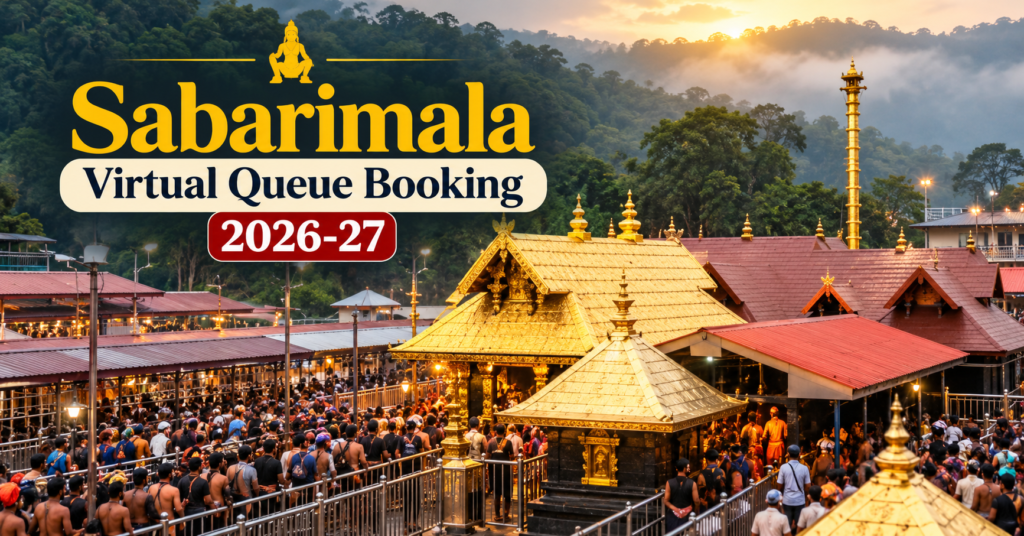
Sabarimala Virtual Queue Booking 2026-27: Quick Details
Before planning a Sabarimala trip in 2026-27, check the temple-opening schedule and Virtual Queue availability first.
| Sabarimala Booking Detail | Information |
|---|---|
| Booking System | Sabarimala Virtual Queue / Virtual Q |
| Virtual Q Fee | Free |
| Main Pilgrimage Season | Mandala–Makaravilakku |
| Expected Mandala Season Start | Around 16 November 2026 |
| Mandala Pooja | Late December 2026 |
| Makaravilakku Season | Late December 2026–January 2027 |
| Makara Jyothi | Usually around mid-January |
| Off-Season Opening | Selected monthly pooja and festival days |
| Virtual Queue Requirement | Generally required on temple-opening days |
| Spot Booking | Available as a fallback on applicable dates |
| Base Camp | Pamba |
| Pamba to Sannidhanam Trek | Around 4–5 km uphill |
| Virtual Q vs VIP Darshan | Virtual Q is not VIP darshan |
The most important planning rule is simple:
Check Sabarimala opening dates and Virtual Queue availability before booking your train, flight, hotel, or onward transport.
Is Sabarimala Virtual Queue Booking Free?
Yes. Sabarimala Virtual Queue booking is free.
The Virtual Q is a crowd-management and scheduled darshan system used to regulate the large number of pilgrims travelling through Pamba to Sannidhanam.
It is not:
- A VIP darshan ticket
- A paid priority pass
- A special-entry fee
- A premium queue
- A guarantee of zero waiting time
Pilgrims may separately pay for services such as:
- Prasadam
- Poojas
- Transport
- Accommodation
- Other optional temple services
These charges are separate from the free Virtual Queue slot.
Is Virtual Queue Booking Mandatory for Sabarimala?
For trip planning, treat Sabarimala Virtual Queue booking as required on temple-opening days unless the administration announces a different arrangement for your date.
This is important not only during the peak Mandala–Makaravilakku season, but also during shorter monthly pooja openings.
A common mistake is assuming that Virtual Q is needed only during the winter pilgrimage season.
That is not a safe approach.
Even when crowds are lower, Sabarimala may still use the same access-management system for pilgrims visiting during monthly poojas or other opening periods.
Is Sabarimala Temple Open Every Day?
No. Sabarimala is not open every day of the year.
Outside the main Mandala–Makaravilakku pilgrimage season, the temple opens only during selected religious periods.
These commonly include:
- Monthly poojas based on the Malayalam calendar
- Vishu
- Temple festival periods
- Mandala Kalam
- Makaravilakku
This makes Sabarimala very different from temples with daily year-round darshan.
If you are considering a visit in months such as June, August, or September, do not assume the temple will be open simply because you can travel on those dates.
The correct sequence is:
Check temple opening date → Check Virtual Queue slot → Plan travel → Book accommodation and transport
That single step can prevent one of the most common mistakes first-time Sabarimala pilgrims make.
Sabarimala Monthly Opening Dates 2026
Sabarimala does not follow fixed Gregorian dates every month because the temple schedule is linked to the Malayalam calendar.
A broad planning pattern for 2026 looks like this:
| Month | Typical Sabarimala Opening Pattern |
|---|---|
| January | Makaravilakku season continues into the month |
| February | Short monthly pooja opening |
| March | Monthly opening or festival-related period |
| April | Monthly pooja and Vishu-related opening |
| May | Short monthly opening |
| June | Short monthly opening |
| July | Short monthly opening |
| August | Short monthly opening |
| September | Short monthly opening |
| October | Monthly opening before Mandala season |
| November | Mandala season begins around mid-month |
| December | Major continuous pilgrimage season |
These are general opening patterns, not guaranteed dates.
The exact Sabarimala opening calendar should always be confirmed for the relevant month before booking travel.
Why Sabarimala Opening Dates Change Every Month
Sabarimala does not simply open on fixed dates such as “the 1st to 5th of every month.”
Because the schedule follows the Malayalam calendar, the corresponding Gregorian dates shift from year to year.
For example:
February 2026 opening dates cannot automatically be reused for February 2027.
The same applies to every monthly pooja period.
If your pilgrimage depends on a particular date, confirm the exact opening window before booking trains, flights, buses, or accommodation.
Sabarimala Mandala Season 2026-27
The most important annual pilgrimage period at Sabarimala is the Mandala season.
For the 2026-27 cycle, the expected seasonal pattern places the beginning around:
mid-November 2026
with approximately 41 days of Mandala observance continuing into late December.
A practical planning estimate is:
around 16 November 2026 onward
with Mandala Pooja falling toward the end of December.
These dates should be treated as expected seasonal timing until the final 2026-27 calendar is officially confirmed.
Sabarimala Mandala Pooja 2026
Mandala Pooja marks the completion of the traditional 41-day Mandala period and is one of the busiest dates of the Sabarimala pilgrimage season.
It usually falls around:
26–27 December
Pilgrims targeting Mandala Pooja should plan much earlier than for an ordinary monthly opening because Virtual Queue slots, transport, and accommodation can fill quickly.
Sabarimala Makaravilakku Season 2026-27
After the Mandala period, Sabarimala enters the Makaravilakku season.
The usual pattern runs approximately from:
late December 2026 through January 2027
with the most important observance taking place around Makara Sankranti / Makara Jyothi in mid-January.
This is another peak pilgrimage period, so expect heavy demand for Virtual Queue slots and travel arrangements.
Makara Jyothi 2027 Date
Makara Jyothi is one of the most important annual observances associated with Sabarimala.
It generally falls around:
14 January 2027
Pilgrims should not finalise travel based only on the usual yearly pattern. The exact date and related temple schedule should be confirmed once the official 2026-27 season calendar is available.
For Makara Jyothi, complete Virtual Queue booking, accommodation, and transport planning as early as possible.
When Does Sabarimala Virtual Queue Booking Open for 2026-27?
There is no single permanent opening date for every Sabarimala Virtual Queue cycle.
For shorter monthly pooja openings, slots may be released relatively close to the temple-opening period.
For the main Mandala–Makaravilakku 2026-27 season, Virtual Queue booking is generally expected to open in advance of the pilgrimage season.
A broad planning estimate is:
early November 2026
for a season beginning around mid-November.
Pilgrims should avoid waiting until the last few days if they are targeting:
- Mandala Pooja
- Makara Jyothi
- Weekends
- Major festival days
- Other peak pilgrimage dates
How to Book Sabarimala Virtual Queue Online 2026-27
Pilgrims can complete Sabarimala Virtual Queue booking online through the official booking system before travelling to Pamba.
Use the official booking portal:
Pilgrims can also check official temple and pilgrimage information through:
Sabarimala Kerala Government Portal
The booking process is straightforward once the required pilgrim details are ready.
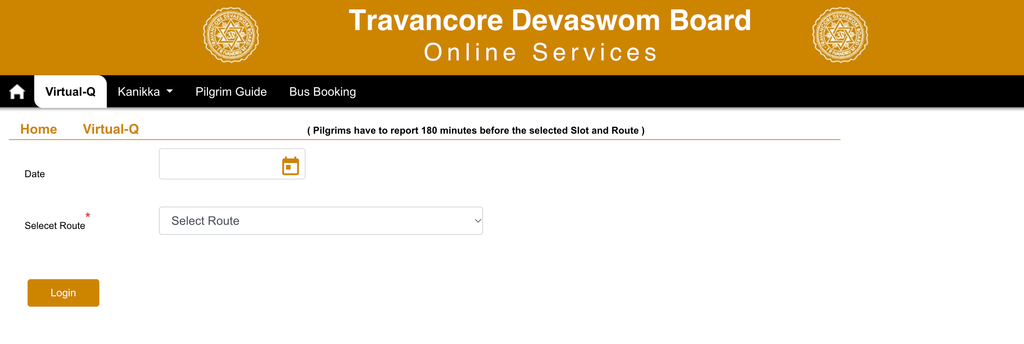
Step 1: Create or open your pilgrim account.
Register using the required mobile number, email address, and personal details.
If you already used the booking system during an earlier pilgrimage season, try recovering the existing account rather than creating a duplicate registration.
Step 2: Select Virtual Queue booking.
After login, open the Virtual Q / Darshan Booking service.
Step 3: Choose your darshan date.
Select one of the dates currently available for booking.
If your intended date is not displayed, it can mean:
- Booking has not opened yet
- Sabarimala is not open on that date
- Available quota is full
- That opening period is being handled under a different arrangement
Step 4: Select an available Virtual Q slot.
Choose the darshan slot that best fits your pilgrimage plan.
Do not treat the slot time as the time you should leave your hotel or vehicle. You still need sufficient time for:
- Travel to Nilakkal or Pamba
- Local transport arrangements
- Virtual Queue and ID verification
- The trek to Sannidhanam
- Crowd and queue movement
Step 5: Enter pilgrim details.
Add the required personal information exactly as it appears on the identification document you plan to carry.
Avoid nicknames, spelling variations, or inconsistent details that could create problems during verification.
Step 6: Add the required ID information.
Enter the identification details requested by the booking system.
Carry the same accepted identity document during the pilgrimage.
Step 7: Confirm and save the Virtual Queue booking.
After successful booking, save the confirmation.
Keep:
- A digital copy
- A screenshot
- A printed copy, if convenient
Keeping an offline copy is useful because mobile connectivity may not always be reliable throughout the pilgrimage route.
When Does Sabarimala Virtual Queue Booking Open?
Virtual Queue booking does not necessarily open on one fixed date for every temple-opening period.
For shorter monthly pooja openings, booking commonly becomes available closer to the opening window, often around 10–15 days in advance.
For the main Mandala–Makaravilakku 2026-27 season, booking generally opens much earlier, with the major seasonal booking window expected around early November, often around 1 November for a mid-November season start.
These should be treated as planning patterns rather than permanent fixed rules.
If you are targeting a major date such as Mandala Pooja, Makara Jyothi, or a peak weekend, check Sabarimala Online Services regularly once the booking period approaches.
Documents Required for Sabarimala Virtual Queue Booking
Pilgrims should carry a valid original identity document matching the booking details.
Depending on the options accepted by the booking system, commonly used identity documents can include:
- Aadhaar
- Passport
- Voter ID
- Other accepted government-issued photo ID
Children may have different identification requirements depending on age and current booking rules.
The safest approach is to carry the same document used during Virtual Queue registration.
Can You Book Sabarimala Virtual Queue for a Group?
The booking system may allow multiple pilgrims to be added under one booking or group reservation.
If you are travelling with family or a larger group:
- Enter every pilgrim correctly
- Use accurate ID details for each person
- Check the current group-size limit
- Keep the group together during verification
- Carry the required identification for every pilgrim
Do not assume that one person’s Virtual Q booking automatically covers companions who were not included in the reservation.
What Happens After Sabarimala Virtual Queue Booking?
A confirmed Virtual Queue slot does not mean the pilgrimage process is complete.
The usual journey still involves:
Reach the pilgrimage zone → Proceed toward Nilakkal/Pamba → Complete required Virtual Q and ID verification → Begin the trek → Reach Sannidhanam → Join the regulated darshan flow
The Virtual Queue manages access to the pilgrimage and darshan system; it does not take pilgrims directly to the sanctum queue.
For that reason, plan enough buffer between your arrival at Pamba and your allotted Virtual Queue period, especially during the Mandala–Makaravilakku season and other crowded opening days.
Sabarimala Virtual Queue Verification at Pamba 2026-27
After reaching the Sabarimala pilgrimage zone, pilgrims should be prepared for Virtual Queue and identity verification before proceeding toward Sannidhanam.
Keep these items easy to access:
- Sabarimala Virtual Q booking confirmation
- Original identity document used during booking
- Required documents for children, where applicable
- Group members included in the booking
- Essential pilgrimage items
Do not keep the booking confirmation or ID buried inside large luggage.
The exact verification point and crowd-management process can change between pilgrimage seasons, so follow the instructions in force during your 2026-27 visit.
Pamba to Sannidhanam Trek: Distance and Difficulty
After reaching Pamba, the pilgrimage continues on foot toward Sannidhanam.
The trek is commonly described as approximately:
4–5 km uphill
but the distance alone does not reflect the physical effort involved.
The time required depends on:
- Fitness level
- Crowd density
- Weather
- Rest stops
- Age
- Luggage
- Pilgrimage-season congestion
Do not estimate the journey as if it were a normal 4–5 km city walk.
For Sabarimala Virtual Queue planning, always keep extra time between reaching Pamba and your darshan slot.
Sabarimala Spot Booking 2026-27
Sabarimala spot booking is a fallback option for pilgrims who reach the pilgrimage area without an advance Virtual Queue slot, where spot-booking facilities are operating.
It should be treated as a backup, not the preferred plan.
Spot booking may involve:
- Limited availability
- Longer waiting
- Additional queues
- Uncertainty on peak dates
For the Mandala–Makaravilakku 2026-27 season, advance Virtual Queue booking is the safer option whenever slots are available.
Sabarimala Virtual Queue vs Spot Booking
| Feature | Virtual Queue | Spot Booking |
|---|---|---|
| Booking Method | In advance | On arrival |
| Cost | Free | Generally registration-based |
| Planning Certainty | Better | Lower |
| Peak Season Use | Recommended | Backup option |
| Waiting | More predictable | Can be longer |
| Best For | Pilgrims with fixed travel plans | Pilgrims arriving without an advance slot |
If your travel date is fixed, Sabarimala Virtual Queue booking is usually the better choice.
What If Sabarimala Virtual Queue Slots Are Full?
If your preferred Sabarimala Virtual Q slot is unavailable, do not immediately pay an agent or unofficial intermediary.
Try these options first:
Check another time slot.
A different darshan period on the same day may still be available.
Check the next available date.
Moving the pilgrimage by one day can sometimes make a major difference.
Check again later.
Slot availability can occasionally change if capacity is adjusted or bookings are cancelled.
Consider spot booking only as a fallback.
Do not assume it will offer the same certainty as advance booking.
During peak dates such as Mandala Pooja, Makara Jyothi, weekends, and late December, changing the travel date may be more practical than relying entirely on walk-in availability.
Is There a Sabarimala VIP Darshan Ticket?
The Sabarimala Virtual Queue is not a VIP darshan ticket.
Pilgrims often search for terms such as:
- Sabarimala VIP Darshan
- Sabarimala VIP ticket
- Sabarimala fast darshan
- Sabarimala special queue
But the Virtual Q itself is a free darshan-management system, not a paid premium-entry product.
If someone asks for a large payment simply to provide a “Virtual Queue VIP slot,” treat the claim cautiously.
Paid poojas, prasadam, accommodation, transport, and other optional services are separate from the free Virtual Queue booking.
Sabarimala for Elderly Pilgrims
The Pamba to Sannidhanam trek can be physically demanding, particularly for elderly devotees.
Families should consider:
- Existing health condition
- Walking ability
- Heat and humidity
- Crowd density
- Medical requirements
- Rest time
- Luggage
Palanquin or doli-type assistance may be available depending on the season and current regulated arrangements.
Sabarimala Virtual Queue vs 41-Day Vratham
The Virtual Queue and the traditional 41-day vratham serve completely different purposes.
Virtual Queue is an administrative booking and crowd-management system.
Vratham is a religious observance followed by devotees before undertaking the pilgrimage.
One does not replace the other.
Booking a Virtual Q slot does not mean the pilgrim has completed the vratham, and observing the vratham does not automatically create a Virtual Queue reservation.
What Is the Sabarimala 41-Day Vratham?
Traditionally, devotees observe approximately 41 days of vratham before the Sabarimala pilgrimage.
Practices commonly associated with the observance include:
- Wearing a mala
- Simple and disciplined living
- Vegetarian or sattvic diet
- Abstaining from alcohol
- Regular prayer
- Self-control
- Wearing black, blue, or saffron clothing
- Following guidance from a Guruswami where applicable
Specific practices can differ between devotee communities and Guruswami traditions.
Irumudi Kettu and the 18 Holy Steps
The Irumudi Kettu is an important part of the traditional Sabarimala pilgrimage.
Pilgrims following the prescribed vratham and carrying the Irumudi are traditionally associated with climbing the sacred:
Pathinettampadi — the 18 Holy Steps
A Virtual Queue booking by itself does not provide access to the traditional 18-step route.
The two requirements serve different purposes.
Can You Visit Sabarimala Without Irumudi?
Yes. Pilgrims can undertake darshan without following the traditional Irumudi route, subject to the entry arrangements applicable during their visit.
The key distinction is:
Irumudi → traditional access to the 18 Holy Steps
Virtual Queue → scheduled darshan access
These are separate parts of the Sabarimala pilgrimage system.
Sabarimala Darshan Timings 2026-27
During major pilgrimage periods, Sabarimala temple operations begin very early in the morning.
A commonly followed pilgrimage-season pattern begins around:
3:00 AM
and continues through morning rituals and darshan.
There is typically an afternoon closure before the temple reopens for evening worship and continues into the night.
Exact darshan timings can vary according to:
- Monthly pooja
- Mandala season
- Makaravilakku season
- Festival days
- Special rituals
For actual trip planning, your Sabarimala Virtual Queue slot should take priority over a generic daily timing table.
Important Daily Rituals at Sabarimala
The Sabarimala daily schedule traditionally includes rituals such as:
- Nirmalyam
- Abhishekam
- Ganapathi Homam
- Neyyabhishekam
- Usha Pooja
- Ucha Pooja
- Deeparadhana
- Athazha Pooja
- Harivarasanam
Among these, Neyyabhishekam has particular importance because of its connection with the traditional Irumudi pilgrimage.
What Is Neyyabhishekam at Sabarimala?
Neyyabhishekam is the ritual offering of ghee to Lord Ayyappa.
Pilgrims traditionally carry ghee-filled coconut as part of the Irumudi Kettu.
It is an important religious offering, but it should not be confused with Virtual Queue booking.
Neyyabhishekam and Virtual Q are separate services.
Nilakkal, Pamba and Sannidhanam: Understand the Route
First-time pilgrims often encounter these three place names repeatedly.
Nilakkal
Nilakkal is a major transport and parking hub used during Sabarimala pilgrimage operations.
Pamba
Pamba is the main base point from which pilgrims begin the climb toward Sannidhanam.
Sannidhanam
Sannidhanam is the hilltop temple area where the main Lord Ayyappa shrine is located.
The pilgrimage route is broadly:
Nilakkal → Pamba → Trek → Sannidhanam → Darshan
The exact transport and access arrangements can vary during the 2026-27 pilgrimage season.
Can You Drive Directly to Sannidhanam?
No. You cannot treat Sabarimala like a normal drive-to-the-temple visit.
Private vehicle movement is heavily regulated, especially during major pilgrimage periods.
Pilgrims should plan for:
- Parking or transport arrangements
- Nilakkal movement
- Bus or regulated onward transport
- Pamba arrival
- Uphill trek to Sannidhanam
Do not assume a taxi or private car can drop you beside the main temple.
Best Time to Book Sabarimala Virtual Queue 2026-27
Once your temple-opening date, travel date, and pilgrim group are confirmed, there is little benefit in delaying Virtual Queue booking.
Book as early as possible if you are targeting:
- Mandala Pooja
- Makara Jyothi 2027
- Peak December dates
- Weekends
- Major festival openings
High-demand slots can fill quickly, so the safest planning order is:
Confirm Sabarimala opening date → Check Virtual Queue availability → Book slot → Finalise travel and accommodation.
Sabarimala Virtual Queue Booking Problems and Fixes
Even after finding an available slot, pilgrims can run into login, OTP, booking confirmation, or account-recovery problems. Most of these issues can be handled without creating a new account.
OTP Not Received During Sabarimala Booking
If the OTP does not arrive:
- Recheck the registered mobile number
- Use the resend option
- Wait briefly before requesting multiple OTPs
- Check whether the same account was created in an earlier season
Avoid creating duplicate accounts unless the portal specifically requires a new registration.
“User Already Exists” Error
This usually means the pilgrim has already registered on the Sabarimala booking system in an earlier season.
Instead of creating another account, use the available:
Forgot Password / Account Recovery / Reset options
This is especially relevant for repeat pilgrims who may have booked several years earlier and no longer remember their login details.
Virtual Q Coupon Not Downloading
If the Virtual Queue confirmation or coupon does not download properly:
- Reopen the booking from your account
- Check booking history
- Retry from another browser or device
- Save a screenshot once the booking becomes visible
- Keep an offline copy before starting the journey
Do not travel without making sure you can show the booking details during verification if required.
Cancelling an Unused Virtual Queue Slot
If your pilgrimage plan changes, cancel the unused slot where cancellation is available.
This is particularly useful during peak periods because releasing an unused reservation can make the slot available to another pilgrim.
Plastic Restrictions at Sabarimala
Sabarimala lies within an ecologically sensitive forest region, so pilgrims should minimise plastic use and follow the waste-control instructions in force during the pilgrimage season.
Carry only what is genuinely needed for the journey.
This has two practical advantages:
- Less weight during the Pamba–Sannidhanam climb
- Less waste along the pilgrimage route
How to Reach Sabarimala in 2026-27
There is no railway station directly beside Sabarimala Temple.
Most pilgrims combine train or air travel with road transport toward Nilakkal, Pamba, or another pilgrimage access point.
By Train
Common rail gateways include:
- Chengannur
- Kottayam
- Tiruvalla
Chengannur is one of the most commonly used railway stations for Sabarimala pilgrims.
By Bus
During the main pilgrimage season, KSRTC operates extensive Sabarimala services connecting major towns, railway stations, and pilgrimage transport hubs.
Pilgrims should check the current seasonal bus arrangements before travelling.
By Air
Major airports used for Sabarimala travel include:
- Cochin International Airport
- Thiruvananthapuram International Airport
From either airport, pilgrims need onward road transport toward the Sabarimala pilgrimage zone.
Sabarimala Accommodation 2026-27
Pilgrims visiting Sabarimala can find accommodation in and around major pilgrimage points such as:
- Nilakkal
- Pamba
- Sannidhanam
- Erumeli
- Pathanamthitta
- Other nearby pilgrim towns
Accommodation demand rises sharply during the Mandala–Makaravilakku 2026-27 season, especially on weekends, Mandala Pooja, and other peak pilgrimage dates.
For a planned visit, the safest order is:
Confirm Sabarimala opening date → Book Virtual Queue → Arrange accommodation → Finalise transport
This is better than reserving a room first and then trying to match your stay with whatever Virtual Queue slots remain.
If you are targeting a peak date, arrange accommodation as soon as your Sabarimala Virtual Queue booking is confirmed.
Common Sabarimala Virtual Queue Mistakes
Booking Travel Before Checking Temple Opening Dates
Sabarimala is not open every day of the year.
Always confirm the temple-opening period before finalising trains, flights, or hotels.
Thinking Virtual Queue Is Paid
The Sabarimala Virtual Q slot is free.
Paid poojas, prasadam, transport, and accommodation are separate services.
Searching for a “VIP Virtual Queue”
Virtual Queue is not a VIP darshan product.
Treat any claim of a paid “VIP Virtual Q slot” cautiously.
Assuming Monthly Pooja Means No Booking Is Needed
Shorter monthly opening periods can still use Virtual Queue access management.
Do not assume off-season automatically means walk-in darshan.
Treating Virtual Q Booking as the Entire Journey
Booking is only one part of the pilgrimage.
You still need to manage:
Travel → Nilakkal/Pamba → Verification → Trek → Sannidhanam → Darshan
Underestimating the Pamba–Sannidhanam Climb
The route is only a few kilometres, but it is an uphill pilgrimage trek and can take much longer during crowded periods.
Confusing Irumudi With Virtual Queue
They serve completely different purposes.
Irumudi is part of the religious pilgrimage tradition.
Virtual Queue is an administrative darshan-booking system.
Planning to Use the 18 Holy Steps Without Irumudi
Traditional access to Pathinettampadi, the 18 Holy Steps, is associated with pilgrims carrying the prescribed Irumudi.
A Virtual Queue booking does not replace that requirement.
Waiting Too Long to Book Peak Dates
High-demand slots for:
- Mandala Pooja
- Makara Jyothi
- Peak December dates
- Weekends
can fill quickly.
Sabarimala Virtual Queue Booking 2026-27 FAQs
Is Sabarimala Virtual Queue booking free?
Yes. The Virtual Q slot itself is free.
Is Sabarimala Virtual Queue mandatory?
Virtual Queue is generally used as the main advance darshan-management system on temple-opening days. Pilgrims should check the arrangement applicable to their specific opening period.
When does Sabarimala Virtual Queue booking open for 2026-27?
Monthly-pooja slots generally open closer to the corresponding temple-opening period, while the main Mandala–Makaravilakku season usually opens earlier, ahead of the mid-November pilgrimage start.
When does Sabarimala Mandala season start in 2026?
The expected seasonal pattern places the start around mid-November 2026, approximately around 16 November, subject to final confirmation.
When is Sabarimala Mandala Pooja 2026?
Mandala Pooja is generally observed in late December, typically around 26–27 December.
When is Makaravilakku 2027?
The Makaravilakku pilgrimage period usually continues through January, with Makara Jyothi generally falling around mid-January.
Is Sabarimala open every month?
Sabarimala normally opens for selected monthly pooja periods outside the main pilgrimage season rather than remaining open every day.
Can I book Sabarimala Virtual Queue for a group?
Group-booking limits can vary by season. Add every pilgrim according to the current booking rules and make sure each person’s details are entered correctly.
Do children need Virtual Queue booking?
Child-specific booking and ID rules can vary. Follow the requirements shown by the booking system for the relevant pilgrimage season.
What ID is required for Sabarimala Virtual Queue?
Carry a valid original identity document matching the booking details.
What if all Sabarimala Virtual Q slots are full?
Try another time slot or another date first. Spot booking may be available as a fallback where operating.
What is Sabarimala spot booking?
Spot booking is an on-site registration option for pilgrims without an advance Virtual Queue slot, subject to current availability and administrative arrangements.
Is spot booking better than Virtual Queue?
No. Advance Virtual Queue booking is generally more predictable for a planned pilgrimage.
Does Virtual Queue provide faster darshan?
It helps regulate darshan access but should not be treated as a paid fast-track or VIP service.
Is there a Sabarimala VIP darshan ticket?
Do not confuse Virtual Queue with VIP darshan. The Virtual Q is a free crowd-management system rather than a paid premium-access ticket.
Do I need Irumudi for Virtual Queue booking?
No. Virtual Queue and Irumudi are separate.
Virtual Queue manages darshan access, while Irumudi belongs to the traditional pilgrimage observance and is connected with the sacred 18-step route.
Can I climb the 18 steps without Irumudi?
Traditional Pathinettampadi access is associated with pilgrims carrying the prescribed Irumudi.
How far is Pamba from Sannidhanam?
The pilgrimage climb is commonly described as approximately 4–5 km uphill.
Can elderly pilgrims reach Sannidhanam?
Yes, but the climb can be physically demanding. Families should plan according to health, walking ability, crowd conditions, and any regulated assistance available during the season.
Sabarimala Virtual Queue 2026-27: Final Planning Order
For Sabarimala, the order in which you plan the pilgrimage matters.
The better sequence is:
Check temple-opening calendar → Choose the pilgrimage date → Book Virtual Queue → Arrange transport → Book accommodation → Prepare for Pamba and the trek
Avoid doing it in reverse:
Book flights → Reserve hotel → Reach Kerala → Discover the temple is closed or Virtual Q is full
And remember the most important distinction:
Sabarimala Virtual Queue is a free darshan-management system. The 41-day vratham, Irumudi, and Pathinettampadi belong to the religious tradition of the pilgrimage.
Understanding that difference, along with confirming the correct Sabarimala opening dates for 2026-27, makes the entire pilgrimage much easier to plan.